Monday, July 20, 2015

2015 Buoy 10 Salmon Season

Buoy 10 King Salmon Season 2015


Every August we flock to the Oregon Coast and settle in for some of the best fishing of the year.  With our Oregon Charter Boat License in hand we're ready to navigate the waters of the lower Columbia River around the Astoria Megler Bridge.  Washington State has had a moratorium on issuing new charter boat licenses since the 1970s which is why we launch from the Oregon side of the Columbia River for this fishery.

Father and Sons with August Salmon near Astoria, Oregon


On a good day there will be 3,000+ Sport Fishing Boats trolling up and down the waterways between Buoy 10, inside the mouth of the Columbia and Tongue Point, just above the bridge.  We will be there every day with you on board catching chrome bright salmon and living up to the expectations we've set after many years of providing you high quality fishing trips.

Courtesy:  Fishing and Hunting News


Fishing for King and Coho Salmon at Astoria is very productive because the Columbia River and it's tributaries provide 73,000 square miles of available streams to the returning salmon.  This large footprint which includes the Kootenei, Pend Oreille, Spokane, Okanagon, Methow, Umatilla, John Day, Deschutes, White Salmon, Wind, Sandy, Willamette, Lewis and Cowlitz Rivers, mean that literally millions upon millions of fish pass under the Astoria Megler Bridge each year making the Columbia River the NW's Salmon Superhighway.

Bill & Co. with Some Nice King and Coho Salmon


The 2015 Columbia River Returns for Fall Fish include 940,000 King or Chinook Salmon and 525,000 Coho or Silver Salmon.  These fish are expected to enter the river between July 15th and September 30th, 2015.  And we will be at the gate waiting for them.

BOOK YOUR 2015 BUOY 10 KING & COHO SALMON TRIP ONLINE HERE or Call/txt 253-389-0359


Monday, June 15, 2015

Summer in the Pacific NW

Summer Vacations and Fishing in the NW

King Salmon Fishing the Upper Cowlitz This Week


It's hard to believe the beauty that awaits to the SE of Olympia and Tacoma in the hills of the Cascade Mountains.  The remote spot just west of White Pass between Mt Rainier and Mt St Helens provides the perfect starting or ending point for the most scenic salmon fishing we've ever offered.  Fish Lake Scanewa where the Cowlitz and Cispus River converge surrounded by evergreen forests and fishing the most beautiful blue green water.  Packwood is an amazing little town with herds of Elk making local residence and many shops and restaraunts in the shadow of the Cascades.


Eastern Washington for Sun and Salmon


Some of the highest action fishing with 20-30+ hookups per day happens just 2 hours east of Seattle near Vantage on the Columbia River.  Catching 6 fish limits of Sockeye, aka 'Reds', is the perfect activity for the entire family.  Enjoy a day on the water in the warm sun surrounded by amazing the amazing geological landscape of Eastern Washington's Columbia River Basin.  Later in July this fishery moves upstream to Brewster which is a stone's throw away from Lake Chelan which is an amazing vacation destination.

GET THERE:  Wanapum is only 2 hours east of Seattle on I-90.  For Brewster take 90 or 2 east and head north past Lake Chelan.

IN ADDITION TO FISHING:  Take in a concert a summer concert at the Gorge.  Visit Moses Lake or the nearby Potholes Reservoir.  Stay at Lake Chelan - we highly recommend taking a boat or plane ride to the remote town of Stehekin if you've never been.  Take HWY 2 to visit the Bavarian town of Leavenworth for some beer and brats.  Or take the North Cascades highway - a must if you've never taking this amazing scenic route will really make you appreciate the beauty Washington State has to offer.   Treat yourself to a visit to Sun Mountain Lodge and take a fly fishing lesson at the lodge.


August and September at the Coast


Our amazing summer of fishing culminates at the Coast when we greet the years run of King and Coho salmon at the mouth of the Columbia River.  This fishery is aptly named Buoy 10 for the red buoy that memorializes the red hot fishing that takes place here every summer.  These are perfect trips for friends, family, customers and vendors.  Clean and professional boats and guides take you out from the dock in the morning and you can have your fish bagged right at the dock.

GET THERE:  Astoria, Oregon is the base camp for this amazing fishery.  Head west at Portland or Olympia and take 101 down to Astoria.

IN ADDITION TO FISHING:  Astoria Oregon is a right between Seaside, Oregon and Long Beach, Washington.  All three towns are set up for a multitude of tourist activities.  Astoria hosts the Columbia River Maritime Museum and there are also Trolley Tours with knowledgeable tour guides of the area.  Seaside, Oregon has miles of beaches, shopping and restaurants.  One highlight is feeding the seals at the Seaside Aquarium.  Long Beach, Washington is also a great vacation spot and boasts museums, tours and carnival rides.  This stretch along the Pacific Coast is rich in history as the location of the first settlements by Lewis and Clark.


Our family has enjoyed these fishing trips and family vacations for many years and are happy to give share our experiences to help make the most of your summer fishing trips.

Call text or email us anytime at casey@fishwaterswest.com or 253-389-0359

Tuesday, January 13, 2015

Our Hearts Beat: Wyn - ooch - ee

Fishing with Casey of Waters West Guide Service
When you fish with us you're not just in another guide boat on the river.  We're not just another guide service headed to the Wynoochee because it's January and the fish are in.  When you're in Casey's boat - you know there's not a better seat on the river.  Not only because he always runs new and up to date drift boats, or because he knows every nook and cranny, every bend every log every underwater rock ledge where the fish hold.  If you're looking for the best of the best for a particular fishery - you've found it.  The long days season after season Casey has spent perfecting his game plan to catch you fish on this river cannot be matched.  He doesn't follow the latest trends and fads in gear or rely on online forums for information.  He knows what works and what has worked for guiding customers to fish for over a decade.  He continues to improve on his own gear set up every season to sharpen his edge for catching you more and more fish.

Tidbit: (* did you know that Casey met, proposed to and married his wife all on the bank of the Wynoochee River?) Wyn - ooch - ee!!


When you decide that you want to fish in January, February or March for Winter Steelhead - maybe you googled fishing the Wynoochee River or a friend referred you to us, maybe you saw an ad on  Facebook.  Or maybe you met us at a Sportsman's Show or follow the reports on Steelhead University.  Whatever it was that got you to call we're grateful for.


Tip Top Customer Service 
When you do contact us - Jessica is always waiting ready to make sure your reservation is complete and accurate.  If you call at 8pm on a Sunday you're going to get an answer.  You can also book online 24/7 - if you call at 3am we probably won't answer :)  We hope our professionalism in scheduling your trips is always evident.  Our customers are very important to us and we never want you to feel any other way.

So you found us, you called or booked online.  You have a confirmation email with reminder emails a week before the trip.  Every day when Casey checks in he gives the daily report to Jessica and confirms whether he needs to meet at a new time.  For this winter season most start times have been 6:15am - meeting at the Chevron in Montesano where Casey has been meeting many of you for over 13 years.  We always recommend staying at the Monte Square Motel which is at this same location.  Very convenient to wake up and meet Casey right in the same parking lot.  ( Monte Square Motel 360-249-4424)

Meeting the Morning of the Trip
At the peak of the season there are trucks and boats everywhere - guides and friends meeting up to fish the famed Wynoochee River.  You spot Casey's black truck and head over to meet him.  Everyone has their coffee and cold weather gear you head up to the take out spot.  You will follow Casey to one of several take out spots on the Wynoochee River.  Twin Bridges, Black Creek, Grandma and Grandpas (private launch), the Culvert, Cross Over or White Bridge.  You leave your vehicle at the take out spot.  Grab all your gear and hop into Casey's truck.  Another point we strive for is your comfort on the ride to the upper launch.  We always have a large 4 door truck or SUV so you'll know when you bring wives or customers that they will be comfortable (as first class as steelhead fishing can be) all the way.

You head up the Valley in the warmth and comfort of the truck.  If this is your first time fishing with Casey you make small talk - you might have lots of questions about the river, the fish, the valley.  Casey may not know that the fish stock for this river last year was 170,300 or that the ancient ancestor of modern salmon and steelhead was the Onorynchus Rastrosus, but he does know how to help you catch the Onorynchus Mykiss (steelhead) currently in the system.  You get to the upper launch - any launch above Twin Bridges (the lowest launch) including the 7400 line bridge or the private launch at Sutherby's.  From the comfort and warmth of the truck you wait while Casey launches and secures the boat.  Then you park put your waders or other warm gear on.  You walk down to the boat launch to the river.  You place your pack in the front of the boat and get in - sit down in those brand new padded seats.  Then Casey hops in and you're off.


Finally on the Water
Bright rays of sun coming up over
the edge of the Wynoochee Valley
It's still dark when you launch so you can barely make out the tree line and where the bank meets the water.  The morning fog is hovering over the water waiting for sunrise and warmth to evaporate.  The morning moonlight is often visible.  And all you can hear are the paddles from the boat lightly splashing as Casey rows you down the river to the first fishing hole.

As you're rowing downriver in the darkness you're wondering when you will get that rod in your hands.  The rods are all neatly lined up behind you - all pre-tied ready to fish.  Maybe you're a bit nervous because it's been so many years since you last caught a lake trout or maybe your excited because you caught a 20lb steelhead last season and you're hoping to see another beautiful monster today.


Suddenly the water flow picks up - small rapids hurry you round the bend and you can see rays of sunlight stretching up over a high cliff overlooking the river valley.  That first bright burst of light reminds you you've been up for hours in the darkness and it's about to pay off.

Time to Catch some Fish

You hear the anchor rope softly dropping and then the thud of the anchor hitting the river bottom.  It's time to fish.  Casey grabs a rod and hands it to you.  He explains that you will be pulling bait divers in this first spot and slides some rod holders closer to your fishing station.  You pull the line out 20 times per Casey's instruction then place your rod in the rod holder.  You sit down and start watching the line and tip of the rod dancing.  The dancing of the rod tip indicates that the plug or diver at the end of your line deep in the cool water is wiggling perfectly - mimicking the action of a small bait fish.

There are likely fish in the slot of water you're fishing right now.  The hatchery steelhead you're targeting were released about 10-12 months previously.  They are returning from several months - sometimes years in the ocean.  They've been out their feeding on the feast of small sea creatures that we rely on to grow our salmon and steelhead.  These fish are biologically programmed to return to the river they were either hatched or released into as fry.  The fast cool water at this spot is perfect for steelhead to sit in as the faster water carries with it more oxygen which efficiently travels through the steelhead's gills and oxygenates their blood.  That is why we know they are likely to be in this spot.  The fish are either there or traveling to this spot up river as you sit and wait.

You take a deep breathe in.  There's nothing like the cool winter air which hovers close to the surface of the Wynoochee River.  The stark white trunks of the alder trees, bare of their spring green leaves, are most visible in the morning light.  The evergreen forests on the surrounding hillsides protect the small creeks and streams keeping them cool as they flow into the Wynoochee.
Perfect Winter Steelhead
Wynoochee January 2014

QUICK.  You're brought back to reality when Casey yells 'you're hit wait for it.'  You wait just a minute for the fish to take the bait.  Once he's hooked you grab your rod out of the holder and set and hook.  Your fishing partner also reels in their line to keep it out of the way of the traveling steelhead attached to the end of your line.  Then the game begins. Casey is excited instructing you to keep your rod tip up in the air.  If you point the rod at the fish it will come off.  Keep your rod tip up.  As you reel the line in you do lower the tip of the rod - but never so low that it points at the water.  Reel reel reel down, pull up.  Reel reel reel down, pull up.  After several plays the fish is in sight still in the cool water, IT JUMPS!  The jump is to distract you - and the fish runs back down river - pulling your line with it.  Keep that rod tip up!!  The drag of the reel stops the fish and you reel reel reel down and pull up.  Reel reel reel down, pull up.  The fish is tired, you're winning this game.  When it comes into view this time you reel it close enough to the boat to see it's chrome bright skin and bright fins.  Before you know what happened there's a net in the water and your fish is caught.  Casey brings the fish in net on board.  SUCCESS!  You caught the first steelhead of the day.  Casey removes the hook from your freshly caught steelhead and instructs you to mark it on your catch record card.  The catch record code for the Wynoochee River is 337.  You fumble in your pocket or bag for your license and a pen.  You find the area of the catch record card designated for marking hatchery steelhead.  You enter the code for the Wynoochee of 337 under the catch area code and then the Day and Month.  You're allowed 2 hatchery fish per day on this river so you have more work to do.


The first fish is in the fish box.  You're ready for round 2.  Casey checks your lines and replaces any bait or gear as needed.  Then you let the line out again.  That familiar dance begins again as the tip of the rod dashes quickly up and down then bounces gently.

If you don't catch another fish in this spot soon - Casey instructs you to reel 'em up.  Rods tucked away safely inside the boat - you head down river.  You pass another boat or two in the morning light.  Other excited fisherman and women out here in nature.  Maybe they nod or wave or congratulate you on the fish they saw you reel in up above.  You thank them and continue down to the next fishing spot.

A wide stretch of river appears which is perfectly suited for 'free drifting.'  You anchor up and Casey prepares some specialized rods with leaders and bait.  Unless you've fished with Casey or one of his close fishing partners you've probably not seen this kind of bait before.  We won't spoil the surprise here.  We'll just tell you this bait is perfectly suited for bouncing along the bottom of the river and catching the notice of unsuspecting steelhead.

Limits of Steelhead January 2015
You take turns casting upstream.  You cast upstream and let the current of the river bring your gear downriver.  You can feel the gear bouncing off the large river rocks on the riverbed.  Bounce bounce bounce.  Once you're gear has drifting down and is nearly parallel with the nose of the boat you reel in and cast back up stream.  The gear is specifically weighted and sized so that the bait is floating mid stream where the steelhead are holding in tight to the small channel.  It's sometimes hard to tell the difference between the feel of your gear bouncing on the river bottom and the soft bite of a steelhead.  But once you recognize the bite you set the hook and start playing that fish.  The others in the boat reel in their lines so they don't tangle with yours.  After some jumps and runs you've wore the fish out and it's netted and boated.  Another fish for the card.

As your day on the water draws to and end you start wondering where the take out is.  You see the river stretching out ahead of you and it's hard to see where the boat launch is from upriver.  All good things must come to and end.   Casey rows the boat up to the launch and drops the anchor.  You're vehicle is waiting at the top of the launch.  You gather your things and take them to your vehicle while Casey cleans your fish.  You bring your cooler down and the fillets go in.

Your sense of accomplishment isn't only about the fresh bright red fillets in your cooler but about taking the time to get out on the water and spend time with a valued friend, family member or customer and your favorite new guide, Casey.


Thursday, November 6, 2014

Best time to Fish (Fishing Guide Perspective)

Disclaimer*  I know that at least one of you uses more advanced tools to look at weather forecasts and possibly river conditions.  In the crowd there are physicists, flight controllers and the like who - I am confident - have better tools to predict weather patterns.  With that said I will walk you through what we look at to decide whether or not a river is at a fishable level.

There are several factors we look at to determine whether or not to recommend rescheduling a fishing trip.  River discharge in cubic feet per second (CFS), water clarity (turbidity), amount of fish in the river, condition of fish in the river and river traffic.  And of course a guides 'gut' feeling (Guides intuition) which is influenced by the above factors.  We are paying guides for their ability to catch fish and if they feel that they cannot catch fish we probably don't want to go out with them.  On the other hand if the river has a higher than average CFS and there are lots of fish in the river and your guide knows he can catch fish then we go for it.

Cowlitz River Fall Silvers Run is from September through November
This was taken late October 2014


Water Flows Cubic ft/s CFS

River discharge is used a lot when I am talking to customers about whether or not we should fish.  
Here are some links that will be helpful for this discussion and for your future reference:


As stated above, the river discharge in CFS is not a good indication of good fishing.  You also have to consider water clarity, amount of fish in the river, condition of fish in the river and river traffic.  Fish have certain habits when migrating up rivers.  In general for the Pacific NW, fish enter the stream and they will move from hole to hole upriver until you catch them or they reach their spawning ground or a fish hatchery.  We can call these 'fishing holes' you've heard of those right?  In order for the fish to move from the ocean or bay into those holes - there needs to be enough water for the fish to swim upstream into those holes and then from hole to hole.  

When there is very low CFS the fish might make it into the first hole or two in the lower section of a river.  The fish will stay there until they are caught or the CFS goes up and they can continue up stream.  There is also a problem with low CFS in that we guide out of boats.  We guide out of many different types of boats with differing hull degrees and different material on the bottom of those boats.  Some boats can easily make it down a river running at 200 CFS while others need 2000 CFS.  Some drift boats have a UHMV bottom on their drift boats which makes it very easy to glide over exposed rocks in the river during extremely low conditions.  Jet sleds can have a higher or lower degree hull which can vary from front to back of the bottom of the boat and dictate what level the river needs to be at for this boat to not hit bottom.  

Rivers can also be 'flooded' taking over nearby roads and fields with large debris floating down them.  This can be unsafe for you and the guides and it's easy to make the decision to reschedule.  When the river is not flooded but running at an above average CFS there are several things happening which go into our decision to recommend rescheduling.  When the river is above a certain level - the fishing holes disappear!  That makes sense right?  The hole that the fish stay in - where catch them - is literally flooded out.  The fish then disperse and are not in any predictable place in the river.   


If you look at this picture of a cross section of a river - the fish are going to be in the area labeled 'fastest current.'  Again, not a fish biologist, but I have been taught that the fish like oxygen rich water because they use their gills to take oxygen out of the water and into their blood stream.  The fast the current in general the more oxygen in the water during normal flows.  When there are rapids or other features which mix the water with the air - that is bringing more oxygen into the water.  On our rivers there are fast spots that are not class I or II rapids but they are still parts of the river where the water will be more oxygen rich and fish will hang out.  The part of the river above labeled fastest current is likely where rapids or other obstacles would be just upstream to increase oxygen in this water.


So if the area labelled fastest current is our fishing hole and the water rises to a level where the distinction of that hole is diminished - then the stream is not at an optimal level for fishing as the fish are not in the fishing holes.  

Goldfish example. .  Imagine placing a goldfish into a regular drinking glass filled with water.  Then take the goldfish in the drinking glass and place it into a bucket of water, a bathtub or a swimming pool.  It's going to be much easier to catch the goldfish when it's only in the drinking glass and progressively harder as you increase the amount of water around the goldfish.

Water Clarity

The Green Color is Best

Notice the Color of the River in the Background as the Perfect Green
Larry with a perfect Cowlitz River Spring Chinook King Salmon

Water clarity is also an important factor in determining whether to reschedule a fishing trip.  We are not using nets to catch these fish.  We are using fishing jigs, cured salmon eggs (roe), prawn bait, spinners and other fishing tackle which are dependent on the fish seeing and accepting your offer.  So in addition to casting in the right place - which we can talk about later - the water has to be clear enough for the fish to see what you're presenting to them without being so clear that they are spooked by seeing you or your boat in the near distance.  

It's a tough proposition.  You're in the river in a boat or in the water with your waders.  You don't want the fish to see you - but you want them to see your lure or bait.  This is why you cast so far from the boat when spinner or bobber fishing and why you pull the line out on your reel so many times when you're anchor fishing.  You want to be as far away from the fish as possible and still be able to get your presentation right in front of or near their mouths.

Another factor in water clarity is the temperature of the water.  Solvents will dissolve more readily in a water solute than a cooler one.  So if the temperature is predicted to be very low or very high on the day of your scheduled trip this will also be taken into consideration.

When the water is very low and clear you would generally use a smaller darker colored presentation and when it is cloudier or has higher turbidity then you would use a larger brighter colored presentation for them to be able to see it better.  Of course you can only make something so small and dark or big and bright and have it be effective in catching a fish while you're nearby.


Abundance of Fish

March 15th through April 20th is next Prime Window for King Salmon


If every other condition is perfect and there are only 4 fish in the river - you could catch those 4 fish and have a great day on the water.  (some of you know where we have done this and we catch every fish that comes into the river each day ) However, this is rarely the case so we like to fish when there are more than 4 fish in the river.    

We fish several different rivers at different time of year for different species of fish.  We will use the fictitious 'Abundance River' as our example.  The Abundance River has 5 runs of fish.  Winter and Summer Steelhead, Spring and Fall Chinook and Coho Salmon.  The Winter Steelhead start coming into the river around November with increasing numbers entering up until the end of January then decreasing numbers entering into April.  In this example the best time to fish would be the end of January even though the season may be from November through April.  And depending on other conditions you could have your best day of fishing in December or March.  We would generally fish this river from mid December through mid March for a run with this timing.

Here is a chart showing the passage of Adult Chinook over the Bonneville Dam for 2014, 2013 and the 10 year average.  This shows how dramatically close you can time the run and choose the best days to fish if the only factor was the Abundance of fish in the river.  You would only want to fish for Spring Chinook on May 1st and Fall Chinook on September 18th or close to those dates.  As you can see there are good numbers of fish going over the Bonneville Dam between April 10th and May 15th and between August 25th and October 11th.  So we fish downstream of the Bonneville dam near Portland between March 15th and April 20th and further downstream from August 1st through September 30th. 


We would not want to target Chinook on the Columbia River below Bonneville dam between November and February based on this chart.  And if all other conditions such as CFS, Turbidity and River traffic were poor on September 18th - you can bet we would be out there fishing though someone may look at the river traffic or CFS and determine by that number alone that fishing should be rescheduled.

Condition of Fish

Spring Chinook are the Best!


When you're fishing in the Ocean for Salmon - they are in the best condition possible.  They are living and feeding and freshly preserved to perfection in the salter waters of the Pacific Ocean.  Fish enter the rivers to spawn and usually die.  Of course the experience of fishing on a large charter boat in the Ocean is much different to a 2 person drift boat trip on the Olympic Peninsula so we are trying to get you the biggest brightest fish possible upriver in that boat.  We do also offer the Columbia River trips where the fish are just in from the ocean fresh.

When the fish are coming into the river fast - when conditions for such are perfect - then you will catch fresh fish with sea lice still attached and they are in near perfect condition.  When conditions are poor and the fish have been stuck in one hole for a while due to lack of water - then their condition is poor.  After some fish spawn they lethargically start drifting back down stream and eventually die.  The river could be loaded with fish but they could be stuck in a hole and dying or have already spawned and be going downstream.

You want strong fresh upriver bound salmon and steelhead. . 

One of the best upriver fish to catch is actually a spring chinook.  They have the longest journey to travel to get back to their spawning grounds so they have extra delicious omega 3 fatty acids which they will burn on the way to their destination.  Many of the Columbia River Spring Chinook are headed to Canada or Idaho - a long way to go.  These fish are sometimes called 'Upriver Brights' and are probably the best quality fish you will catch in the Pacific NW.  They stay in the best condition the longest while in the river.

River Traffic

Beware of the Bikini and Board Short clad bunch swimming in the fishing hole 


Photo credit: http://www.snippetandink.com/photo-features/sneak-peek-dottie-jordan/

River traffic can comprise of bank anglers, other boat fisherman and guides, recreational river users and commercial traffic.  Our biggest concerns are the first 3 in that order.  One of the advantages to fishing with a guide in a boat is that you will likely have more spots on the river which can be accessed by boat only which will be free of foot traffic.  There are times, however, when the fish are only in one hole on the river and all the boats and bank anglers are at the same spot.  

Weekends bring the biggest crowds for both bank anglers and other boat fisherman.  This is why we always recommend fishing during the week when there is less traffic.  The smaller the river the bigger this factor plays in deciding to recommend rescheduling.  There may only be 1-10 holes or slots to fish in a river and if there are 200 boats and 50 bank anglers then your chances of catching fish are very low.

Recreational river users would include inter tube floaters and kayakers in the summertime.  When the temperatures in the NW approach 80 degrees people naturally want to head to the nearest swimming hole or river and swim or go for a nice float.  On a hot busy August weekend there can be hundred of people floating down the 'Abundance River' and they could care less if they are floating over or swimming in your fishing hole.  Needless to say - fishing on a weekend in a small river when it's 90 degrees is out of the questions.  At best we can accomplish an early morning float - catch our limit and hope to be out of there before there is a bikini and board shorts clad group of teenagers swimming with the fish.


Guides Intuition

I am not a psychologist so I can only guess what factors go into whether or not a guide thinks that fishing will be good enough to take a paying customer.  Some guides don't want to take a paying customer unless all conditions are perfect.  CFS, Turbidity, Abundance of fish, Condition of fish and river traffic.  Some guides have experienced catching lots of fish in dirty water or at high CFS and are confident they can catch fish in less than perfect conditions.  Of course, we are also making these decisions 12-48 hours before a fishing trip and it can be hard to guess what the exact CFS and Turbidity are going to be between 5am and 2pm the day of your scheduled fishing trip.  


RECAP Examples

Example 1:  River is loaded with fish, it's peak season - the fish are bright and perfect for the grill.  The river is a little bit on the clear side but definitely fishable.  CFS is perfect for the boat you're scheduled for.  But. . it's going to be 90 degrees by noon and it's August.  So we know that there will be lots of recreational swimmers and the like around all of our fishing holes - and earlier than normal since the temperature will be so high so early in the day.  We would recommend waiting a week until temps cool down.

Example 2:  All river conditions are perfect.  CFS, Turbidity, River Traffic - all good.  You're booked for March 20th and the fish just have not come into the part of the river that we're fishing yet.  We would recommend rescheduling if there are absolutely no fish to be caught.  Of course they will be showing up any day - so your scheduled day could be the day - we will communicate the facts with you.  

Example 3:  It's scheduled to rain 3 inches between today and 2 days from now when your trip is scheduled for the Satsop River.  3 inches of rain in 2 days will drown out the fish in the holes and the water will be very dirty.  CFS and Turbidity are poor - even if the river is loaded with fish 3 inches of rain is a trip killer.  SPIN:  If the river is absolutely loaded with fish and it's the peak week of the run and it's going to rain 2 inches before your trip - we might suggest going anyways if your guide is confident we will catch fish.

Example 4:  Your scheduled to fish the Queets River on January 3rd.  This is an excellent date for Winter Steelhead but the water is at a high CFS and high turbidity.  The Wynoochee which is a dam controlled river will stay at a lower CFS with lower turbidity - it could be the perfect green color when the Queets is completely flooded out.  So we would suggest switching rivers in this case.


Experience is #1

We are very experienced fishing all of the river we guide on.  In addition to Casey's experience fishing and guiding, Jessica's experience weighing these above factor s day to day and educating customers - we strive to find the best fishing guides for the best fisheries during the peak seasons.

When you book a fishing trip with you are guaranteed that we have spent thousands of hours in learning and preparation for YOUR day on the water.  

Any trip that you book with us will be with a guide who is confident fishing in less than perfect conditions and we will always communicate with you in advance if the odds are stacked against you and give you the option to reschedule your fishing trip or move to a different river with better conditions.

Our goal is to match as many customers up with as many guides as possible - while ensuring the customer has the best possible time on the water and catches fish and the guide is confident and happy fishing there as well.

Check out our online availability for Fishing Trips - Book a Trip Entirely Online


Jessica is always available with any question big or small during your trip booking/decision making process.  Call or text 253.389.0359 or email jessica@fishwaterswest.com


Thursday, October 30, 2014

Columbia River 2014 Salmon Wrap Up

What an amazing Summer it was on the Columbia River.  Many of us are often nostalgic for a history we have never seen or experienced.  A time and place where loading friends and family into a small fishing boat and heading out on the Ocean, Lake or River produced more fish than you really knew what to do with at the end of the day.  From the record Spring Chinook and Sockeye Salmon on the east side of the cascades to the most amazing Buoy 10 Salmon season we've ever seen.

Sockeye Salmon July 2014 Near Wanapum Dam

We don't always fish for Sockeye Salmon but when they won't get off our line while we're fishing for upriver Spring Chinook. . you take what you can get I guess.  For those who were brave enough to drive alternate routes around the Pateros wildfires found easy 6 fish limits of bright Columbia River Sockeye.  As Eastern Washington is a popular vacation area for many of us Coastal Inhabitants - the opportunity to add a half day salmon fishing trip to your daily list of activities made for a lot of happy campers.

There was a lot of hype for both the Spring and Summer/Fall Run of Chinook for the Columbia River in 2014.  Most of the numbers for fish reaching barriers are in - check out the Columbia River Fish Counts for yourself.  Wow - 1.15 Million Chinook over Bonneville Dam with hundred of Chinook still crossing daily at the end of October and thousands of Coho crossing.  We helped clients catch a fair number of Spring Chinook on the Columbia near Portland in late March and early April.

Spring Chinook near Portland March 2014
"Springer Fever" is what fisherman get late winter in lieu of Cabin Fever.  We start ordering fishing leaders, flashers and herring in anticipation of the first King Salmon of the year.  They start trickling into the Columbia River in February when the first catch reports start spreading.  Then by the end of March there are significant numbers available to catch from about Tongue Point upriver to around Camas.  The Spring Chinook fishery is enjoyable as there is good action and most of the fishing is done while trolling.  You also get the added bonus of Mount Hood being the backdrop for your trip.  

Be sure to subscribe to our blog to get pre-season updates for the Portland/Vancouver Spring Chinook Fishery.  You can book a full boat for Spring Chinook now and buy the boat for only $999 which pencils out to only $166.50/person.  You can book a Spring Chinook Charter Online Here.

The 2014 Buoy 10 Season was also amazing.  The forecast was for 1.6 million Chinook and 980,000 Coho.  It looks like the Chinook forecast will run a little short as we are still just shy of 1 million Chinook including jacks for 2014 so far.  The Coho totals may also appear to be coming in significantly lower than the 980,000 predicted.  We did not feel any significant shortages during the August/September Buoy 10 Season.  We crushed the Kings in August and the fishing for Coho in September was really the best we've ever seen.  If only this season lasted year round the world would be a better place.  At least our world would be.  The catch reports from fish and wildlife below are much lower than what we were seeing:


Aug. 1: 43 boats with 107 anglers caught 13 chinook and 15 hatchery coho.Aug. 2: 46 boats with 118 anglers caught 31 chinook and 25 hatchery coho. Aerial flight survey showed 225 boats on the water at Buoy-10.

Aug. 3: 46 boats with 126 anglers caught 33 chinook and eight hatchery coho.

Aug. 4: 53 boats with 138 anglers caught 31 chinook and five hatchery coho
; one charter boat with five anglers caught no fish.

Aug. 5: No sampling conducted.

Aug. 6: 30 boats with 75 anglers caught 22 chinook.

Aug. 7: 48 boats with 119 anglers caught 20 chinook and 16 hatchery coho.

Aug. 8: Five boats with 11 anglers caught two chinook and eight hatchery coho.

Aug, 9: 90 boats with 254 anglers caught 33 chinook and 90 hatchery coho.

Aug. 10: 97 boats with 283 anglers caught 26 chinook and 173 hatchery coho.

Aug. 11: 87 boats with 216 anglers caught 34 chinook and 115 hatchery coho.

Aug. 12: 45 boats with 112 anglers caught 10 chinook and 19 hatchery coho.

Aug. 13: No sampling conducted.

Aug. 14: 98 boats with 259 anglers caught 52 chinook and nine hatchery coho.

Aug. 15: 85 boats with 252 anglers caught 79 chinook and 30 hatchery coho.

Aug. 16: 120 boats with 370 anglers caught 139 chinook and 59 hatchery coho.

Aug. 17: 136 boats with 371 anglers caught 99 chinook and 62 hatchery coho; 
two charter boats with 22 anglers caught no fish.

Aug. 18: No sampling conducted.

Aug. 19: 112 boats with 355 anglers caught 122 chinook and 68 hatchery coho.

Aug. 20: 59 boats with 156 anglers caught 45 chinook and 35 hatchery coho.

Aug. 21: 43 boats with 111 anglers caught 16 chinook and 16 hatchery coho.

Aug. 22: 44 boats with 131 anglers caught 41 chinook and 53 hatchery coho.

Aug. 23: 134 boats with 361 anglers caught 85 chinook and 120 hatchery coho.

Aug. 24: 87 boats with 235 anglers caught 71 chinook and 105 hatchery coho.

Aug. 25: 43 boats with 126 anglers caught nine chinook and 52 hatchery coho.

I am not sure what was happening on those charter boats that showed up to the dock with no fish but we were close to or at limits every day from August 2nd through mid-September when we had to go home to the Grays Harbor Area Rivers.

Coho Limits in September
If you're looking for a small group charter for August or September 2015 we promise you'll have a great time and will catch as many or more fish than most other boats.  You can book an August 2014 Buoy 10 Fishing Charter Here.  We will be moored at the West Mooring Basin in Astoria and will fish between the Astoria Megler Bridge and Buoy 10 - all within the Columbia River Estuary.  


Lots of Big Kings Caught in August 2014 at Buoy 10


Wednesday, June 18, 2014

Historical Decline of Columbia River Fall Salmon

Salmon belong to a family of fish called Salmonidae. This family appeared between 30 and 50 million years ago with modern salmon appearing in the fossil record about six million years ago. All species of salmon are anadromous, which means adults migrate from the ocean to freshwater streams to deposit their eggs. After variable periods of rearing in freshwater, juvenile salmon migrate to the ocean to grow and mature, when the lifecycle repeats itself with the next generation. Except as noted, all salmon are semelparous, meaning that they die after spawning once.
Four main species of salmon return to the Columbia River:
Salmon once occupied nearly 13,000 miles of Columbia River Basin streams and rivers. According to conservative estimates, the Columbia River Basin, both above and below Bonneville Dam, once produced between 10 and 16 million salmon annually. Historically, salmon runs in the Columbia River Basin consisted of 16% fall chinook, 12% spring chinook, 30% summer chinook, 11% coho, 23% sockeye, 8% steelhead, and less than 1% chum. These runs generally extended from March through October, though steelhead runs extended through the winter. Below is a video showing how the area accessible to salmon has been reduced over the 120 years between 1890 and 2011.


Wild Salmon Life Cycle

After 1 to 7 years in the ocean, the adult salmon that have survived countless hazards from predators, ocean conditions, and commercial harvest return to the Columbia River and head for their home streams.
Arriving at her home stream, a female builds a nest, or redd, in fine, clean gravel.
As a female deposits her thousands of eggs, a male releases milt, fertilizing them. Both male and female salmon die soon after spawning, except steelhead and cutthroat, which may survive another year or more to spawn again.
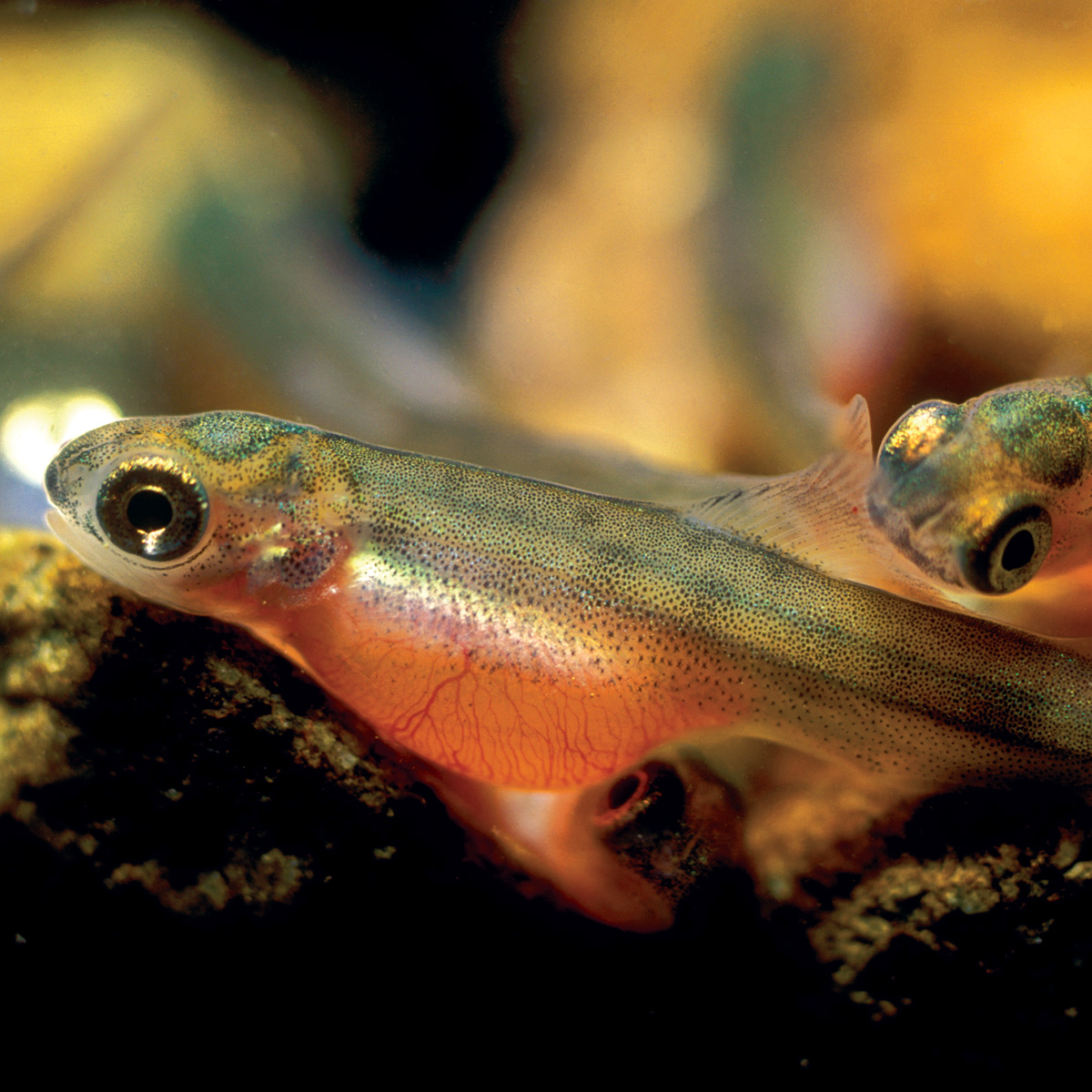
Yolk-sac fry, or alevins
enlarge +
Jeffrey Rich photo
Tiny yolk-sac fry, or alevins, hatch after 2 to 8 months.  They stay in the gravel for another 1 to 3 months until the food from the yolk sac is used up.  They need cold, pure water to breathe and wash away their wastes.
The fry emerge from the gravel and begin to feed on their own.  Many are lost to predators, competition, or failure to adapt to stream conditions.  Some types of salmon begin their migration downstream soon after emergence, while others stay in freshwater for a year or more.
During migration the fry are vulnerable to predators, such as birds or northern pikeminnow, walleye, and bass, which thrive in the reservoirs.  Seven to 15 percent die passing each dam.
By the time they reach the estuary, the fry have become smolts, and their bodies are adapting to saltwater. Here they linger to feed and grow before entering the ocean.  Predators, unfavorable conditions, and failure to adapt will deplete their numbers further.
Once adapted to the ocean, the smolts will spend one to seven years in the ocean, migrating thousands of miles and growing into adults before returning to their home streams to repeat the cycle.
- See more at: http://www.critfc.org/salmon-culture/columbia-river-salmon/#sthash.K2c9DXeQ.dpuf

Big runs of Columbia River chinook, coho highlight 2014 salmon forecasts

OLYMPIA - Salmon fishing in the ocean and the Columbia River this summer could be great thanks to an abundant run of hatchery coho and a potentially historic return of chinook, according to state fishery managers.
Opportunities for anglers also look good in Puget Sound, where another strong run of coho salmon is expected this year.
The forecasts - developed by the Washington Department of Fish and Wildlife (WDFW) and treaty Indian tribes - for chinook, coho, sockeye and chum salmon were released at a public meeting in Olympia today, marking the starting point for developing 2014 salmon-fishing seasons.
Ron Warren, fisheries policy lead for WDFW, said protecting and restoring weak wild salmon populations will continue to be the top priority as fishery managers develop salmon seasons.
"It's early in the process, but these forecasts point to an exciting summer of salmon fishing," Warren said. "We look forward to working with our tribal co-managers and constituents to establish fishing opportunities on abundant runs of hatchery salmon while ensuring we meet our conservation goals for wild fish populations."
This year's forecasts include a return of more than 1.6 million Columbia River fall chinook salmon - which would be the largest since record-keeping began in 1938. A return of nearly 1 million Columbia River coho salmon is expected back this summer as well.
"This certainly could be a banner year for summer salmon fisheries, particularly off the Washington coast and in the Columbia River," Warren said.
As in past years, salmon-fishing prospects in 2014 vary by area:
  • Columbia River: Of the 1.6 million fall chinook expected to return to the Columbia River this season, nearly 86 percent of those fish are "bright" stocks. Those fish, most of which are destined for areas above Bonneville Dam, are the foundation of the in-river recreational salmon fishery.

    If that run comes in as forecast, the total number of brights would exceed last year's entire Columbia River run of 1.2 million chinook salmon. Additionally, the ocean abundance of Columbia River coho is forecast to be about 964,000 fish, three times as many fish as last year's actual abundance.
  • Washington's ocean waters: The strong return of Columbia River salmon should also boost fisheries in the ocean this year.

    About 225,000 lower river hatchery chinook are expected back this season, 35,000 more fish than last year's return. Those salmon, known as "tules," are the backbone of the recreational ocean chinook fishery.

    The abundant coho salmon return projected for the Columbia River will contribute to fisheries off the coast of Washington as well, said Doug Milward, ocean salmon fishery manager for WDFW.

    "This is the first time in more than a decade we have had exceptionally strong forecasts for chinook and coho in the same year," Milward said. "That's good news for anglers because those abundant runs could result in higher catch quotas for both species this summer in the ocean."
  • Puget Sound: Summer/fall chinook salmon returns to Puget Sound are expected to total nearly 283,000 fish, slightly higher than last year's forecast. Most chinook fisheries in Puget Sound, where hatchery chinook make up the bulk of the returning fish, will be similar to last year, said Ryan Lothrop, recreational fishery manager for WDFW.

    A strong run of coho salmon is expected back to Puget Sound as well. Nearly 873,000 coho are forecast to return to the Sound's streams, similar to last year's projection. Lothrop said bright spots for coho include the Nisqually, Skokomish, Skagit, Stillaguamish and Snohomish rivers, as well as Lake Washington and the marine waters of mid- and south Puget Sound.

    Another bright spot is Baker Lake, where an abundant sockeye return of 35,000 salmon is expected back this year. Fishery managers will once again consider sockeye fisheries in Baker Lake and the Skagit River, Lothrop said.

    Another possibility is bonus bag limits for sockeye during summer salmon fisheries in marine areas around the San Juan Islands and in the Strait of Juan de Fuca. "About 23 million sockeye salmon are forecast to return to Canada's Fraser River this year, and a portion of those fish will make their way through those marine areas," Lothrop said.

    However, a sockeye fishery in Lake Washington is unlikely this year, Lothrop said. The sockeye forecast is about 167,000, well below the minimum return of 350,000 sockeye needed to consider opening a recreational fishery in the lake.
State, tribal and federal fishery managers will meet March 8-13 in Sacramento with the Pacific Fishery Management Council (PFMC) to develop options for this year's commercial and recreational ocean chinook and coho salmon fisheries. The PFMC establishes fishing seasons in ocean waters three to 200 miles off the Pacific coast.
Additional public meetings have been scheduled through March to discuss regional fishery issues. Input from these regional discussions will be considered as the season-setting process moves into the "North of Falcon" and PFMC meetings, which will determine the final 2014 salmon seasons.
The PFMC is expected to adopt final ocean fishing seasons and harvest levels at its April 5-10 meeting in Vancouver, Wash. The 2014 salmon fisheries package for Washington's inside waters will be completed by the state and tribal co-managers during the PFMC's April meeting.
A meeting schedule, salmon forecasts and information about the salmon season-setting process are available on WDFW's website athttp://wdfw.wa.gov/fishing/northfalcon/